The vision of Isogeometric Analysis was first presented in a paper published October 1, 2005 . Since then it has become a focus of research within both the fields of Finite Element Analysis (FEA) and Computer Aided Design (CAD) and is rapidly becoming a mainstream analysis methodology and a new paradigm for geometric design . […]
Events
Filters
2 events,
The recent artificial intelligence (AI) boom has been largely driven by three confluence forces: algorithms, big data, and computing power enabled by modern integrated circuits (ICs) including specialized AI accelerators. In this talk, I will present a synergistic approach on AI and intelligent IC/accelerator designs with two main themes, AI for IC and IC for […]
3 events,
Abstract: Fourier ptychographic microscopy is a technique that achieves a high space-bandwidth product, i.e. high resolution and high field-of-view. In Fourier ptychographic microscopy, variable illumination patterns are used to collect multiple low-resolution images. These low-resolution images are then computationally combined to create an image with resolution exceeding that of any single image from the microscope. […]
Abstract: Charged polymers known as polyelectrolytes have been studied for decades, however, understanding their physical properties remains a persistent challenge for polymer scientists. This difficulty stems from the intricate interplay between length scales spanning as much as 3-4 orders of magnitude, which has stymied our understanding of a truly important class of polymers; polyelectrolytes are […]
We invite you to join an exclusive event with Penn Engineering alumni who will share their stories on how they have thrived in the startup ecosystem. These alums range from an angel investor in Uber, a serial biotech entrepreneur with several exits, an entrepreneur who has generated over half a billion in licensing deals and […]
3 events,
Polymer brushes are a common feature in many biological surfaces. The ability to rapidly transform a substrate from a hard, structural material to a soft, hydrogel structure over the course of a few tens of nanometers makes polymer brushes elegant materials for tailoring the biology-materials interface. Polymer brushes, because of their surface confinement, are typically […]
In my talk, I will first describe one of the main projects in my lab that investigates the underlying cellular-molecular mechanisms for changes in alcohol sensitivity of crayfish with different prior social experiences. In this context, I will explain why “simple” invertebrates may provide unique advantages for studying complex phenomena such as socially-dependent drug effects. […]
Abstract: The connections between geometry and mechanics have been explored for centuries. How these connections shape computation is a question we are just beginning to explore. If computers can predict how materials move and deform, they can help us to understand, anticipate and manipulate the physical world. Our group develops models and algorithms that capture the characteristic behavior […]
1 event,
Abstract: In this talk we present a concurrent atomistic-continuum (CAC) method for modeling and simulation of transport processes in crystalline materials. The CAC formulation extends the Irving-Kirkwood procedure for deriving transport equations and fluxes for homogenized molecular systems to that for polyatomic crystalline materials by employing a concurrent two- level structural description of crystals. A multiscale […]
3 events,
The demand for autonomous devices, including intelligent sensor platforms for IOT applications, is driving a parallel need for efficient energy storage systems that are inexpensive to produce, exhibit high power and energy densities, and occupy a minimum footprint on the device. Necessary enhancement in the performance of batteries and supercapacitors can be realized by fabrication […]
Abstract: This talk will present our latest research adventures on 2D nanomaterials towards greater scientific understanding and advanced engineering applications. In particular the talk will highlight our work on flexible electronics, zero-power devices, monolayer memory (atomristors), non-volatile RF switches, and wearable tattoo sensors. Non-volatile memory devices based on 2D materials are an application of defects […]
This two-part talk will describe the scope of work and emergent findings of two ongoing National Science Foundation Cultivating Cultures of Ethical STEM (CCESTEM) projects. Each project seeks to provide strategies for the design, assessment, and research of learners’ ethical formation. The first project, an Institutional Transformation CCESTEM project (Award #1737157), seeks to utilize Faculty […]
1 event,
This talk is concerned with the use of nonlinear homogenization to study the effective response of composites. We look to illustrate the effect that constitutive assumptions have on the methods by which such estimates can be obtained, as well as on the actual effective, or homogenized, response of the material. Although helpful in ensuring existence […]
2 events,
Abstract: Conventional methods in microbiology can be limited by long assay execution and analysis times, large reagent volumes, and high single-use supply costs. These limitations can be overcome using drop-based microfluidics in which picoliter-sized, water-in-oil emulsions serve as independent microreactors, allowing for the compartmentalization of microbes and high-throughput assaying at the single cell level. Here, […]
1 event,
The 2016 Nobel Prize in Physics was awarded to Kosterlitz, Thouless, and Haldane for their pioneering theoretical work on the novel and counter-intuitive phases of matter that are now referred to as topological phases. Almost half a century after these researchers applied powerful mathematical techniques of topology to condensed matter systems, a new rapidly developing […]
1 event,
Abstract: An all-wireless vision connecting billions of devices is finally in sight with the Internet-of-Everything paradigm. This vision entails large networks with dynamic connectivity, ad hoc formation and heterogeneous nodes. Central to be able to integrate all our lives to this massive virtual domain is security and privacy of the information that flows through it. […]
4 events,
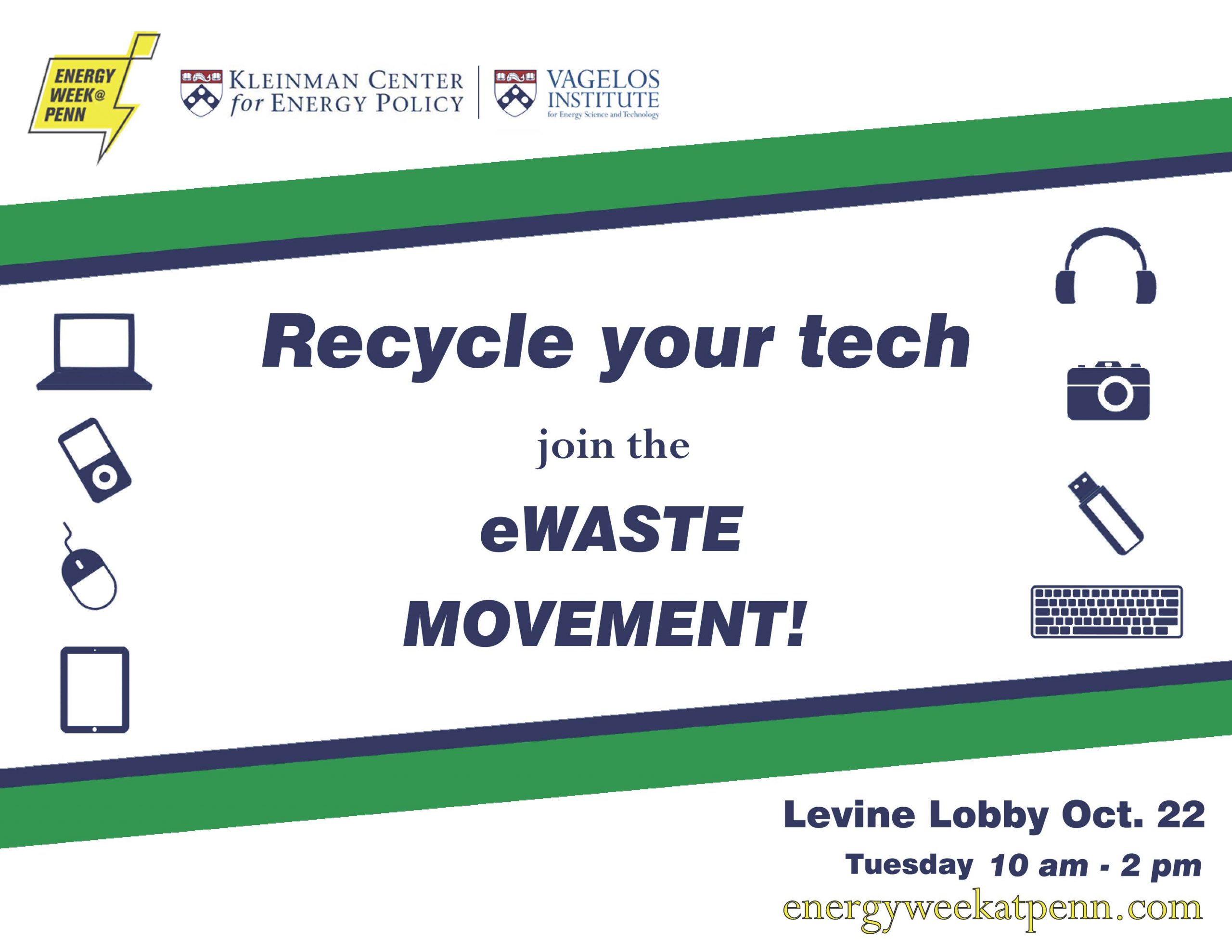
We will be collecting EWASTE items in Levine Lobby on Tuesday in support of Energy Week @ Penn campaign. This is a great opportunity to properly recycle non-traditional items such as: computers & printers computer accessories (keyboards, mice) Monitors, TVs, Displays Mobile phones household electronics (anything with a plug!) light bulbs non-recyclable glass
Structural biological materials, such as animal bones and shells, display remarkable mechanical properties despite being composed of quite simple and ordinary constituent materials. For example, the toughness of nacre, a structural biological material found in the shells of some mollusks, is orders of magnitude higher than that of its primary constituent—the calcium based mineral aragonite. […]
Thesis Committee: Ravi Radhakrishnan, Ph.D., advisor; Dennis Discher, PhD; Scott Diamond, PhD; and Wei Guo, PhD
2 events,
Abstract: Recent advances in machine learning, computer vision, natural language processing, and robotics, offer a tremendous opportunity to transform medicine, from reactive and hospital centered to proactive and patient-centered. To fulfill this promise, new methods need to be developed which are more interpretable, can handle data at multiple spatial and temporal scales, and are robust […]
Abstract: One of the grand challenges facing humanity today is the development of an alternative energy system that is safe, clean, and sustainable. A Distributed Renewable Electrochemical Energy and Mobility System (DREEMS) can meet this challenge. At the foundation of this new energy system, we have chosen to study fuel cells, electrolyzers, and flow batteries. […]
2 events,
Abstract: This presentation is focused on Isogeometric Analysis (IGA) with applications to solids and structures, starting with early developments and results, and transitioning to more recent work. Novel IGA-based thin-shell formulations are discussed, and applications to progressive damage modeling in composite laminates due to low-velocity impact and their residual-strength prediction are shown. Fluid--structure interaction (FSI) employing […]
Recent years have seen a flurry of activity in solving statistical estimation and learning problems via nonconvex optimization. While conventional wisdom often takes a dim view of nonconvex optimization algorithms due to their susceptibility to spurious local minima, simple iterative methods such as gradient descent have been remarkably successful in practice. The theoretical footings, however, […]
2 events,
Abstract: Quadrotors and multirotors in general are common in many inspection and surveillance applications. For these applications, visual-inertial odometry is a common way to localize the vehicles and observe the environment. However, unlike with wheeled mobile robots, quadrotor localization algorithms often do not use knowledge of the control inputs and the full vehicle dynamics as […]
2 events,
Our group at the University of Minnesota focuses on fundamental advances in numerical algorithms, and understanding of flow physics that allow the prediction of engineering turbulent flows. This presentation will discuss key aspects of such simulation alongside illustrative examples. We will discuss a recently developed unstructured overset grid methodology and its application to particle-resolved DNS […]
Abstract : Optically active spins in solids offer exciting opportunities as scalable and feasible quantum-optical devices. Numerous material platforms including diamond, semiconductors, and atomically thin 2d materials are under investigation, where each platform brings some advantages of control and feasibility along with other challenges. The inherently mesoscopic nature of solid-state platforms leads to a multitude of […]
2 events,
Abstract: The ability to integrate dissimilar materials with different crystal structures and properties enables heterostructures to be developed with new functionality well beyond the normal band gap engineering offered by semiconductor heterostructures. The combination of metals, semiconductors, insulators, magnetic, piezoelectric, structural and phase change materials offers the potential for nearly limitless control of device properties. […]
Abstract: Since Dow first formed a global reaction engineering discipline over twenty years ago, we have accumulated much experience leading and supporting a diversity of reaction engineering projects for our corporation. This presentation will provide specific examples of real-world reaction engineering problems at Dow in the past 27 years and summarize our perspective regarding the […]
2 events,
The rapidly diversifying face of colleges and universities in the United States including the University of Pennsylvania require that we are able to manage intercultural relationships from different backgrounds. We are all working in a multicultural institution, with students, faculty and staff from all over the world. This makes for a very diverse, vibrant community […]
Rapid, quantitative molecular diagnostics in the field, at home, and in resource poor settings is needed for evidence-based disease management, control, and prevention. Conventional molecular diagnostics requires extensive sample preparation, sophisticated instruments, and trained personnel, restricting their use to centralized laboratories. To overcome the limitations of laboratory-based procedures, we designed a simple, inexpensive, hand-held, smartphone-based […]
1 event,
Abstract Two recent advancements of high-order spectral difference (SD) method for computational fluid dynamics on unstructured meshes will be presented. The first progress is our contribution to a new curved sliding-mesh approach to the SD method for simulating flapping and rotary wing aerodynamics. The second elevation of the SD method is our recent successful design […]
