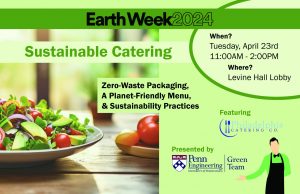
• Sustainable Catering – Earth Week 2024

    /
    Lobby and Mezzanine, Levine Hall 3330 Walnut Street, Philadelphia, PA, United States

    Learn about sustainable products and practices your caterer can implement to reduce waste, minimize plastic and lower carbon footprint. Planet-friendly menu Plastic-alternative packaging and utensils Nutrition label for customized eating preferences Vendor engagement beyond delivery.

    MEAM Master’s Thesis Defense: “Gaussian Process-Based Active Exploration Strategies in Vision and Touch”

    /
    Meyerson Hall, Room B2 210 S. 34th Street, Philadelphia, PA, United States

    Robots struggle to understand object properties like shape, material, and semantics due to limited prior knowledge, hindering manipulation in unstructured environments. In contrast, humans learn these properties through interactive multi-sensor exploration. This work proposes fusing visual and tactile observations into a unified Gaussian Process Distance Field (GPDF) representation for active perception of object properties. While […]

    PICS Colloquium: “Exploiting time-domain parallelism to accelerate neural network training and PDE constrained optimization”

    /
    PICS Conference Room 534 - A Wing , 5th Floor 3401 Walnut Street, Philadelphia, PA, United States

    This talk will explore methods for accelerating numerical optimization constrained by transient problems using parallelism. Two types of transient problems will be considered. In the first case training algorithms for Neural ODEs will be discussed. Neural ODEs are a class of neural network architecture where the depth of the neural network (the layers) is modeled […]

    ASSET Seminar: “Statistical Methods for Trustworthy Language Modeling” (Tatsu Hashimoto, Stanford University)

    /
    Raisler Lounge (Room 225), Towne Building 220 South 33rd Street, Philadelphia, PA, United States

    ABSTRACT: Language models work well, but they are far from trustworthy. Major open questions remain on high-stakes issues such as detecting benchmark contamination, identifying LM-generated text, and reliably generating factually correct outputs. Addressing these challenges will require us to build more precise, reliable algorithms and evaluations that provide guarantees that we can trust. Despite the […]

    Spring 2024 GRASP SFI: Harish Ravichandar, Georgia Institute of Technology, “New Wine in an Old Bottle: A Structured Approach to Democratize Robot Learning”

    /
    Levine 307 3330 Walnut Street, Philadelphia, PA, United States

    This will be a hybrid event with in-person attendance in Levine 307 and virtual attendance on Zoom. ABSTRACT Decades of rigorous research in dynamical systems and control helped us integrate robots into a wide variety of domains, ranging from factory floors to the moon. Today, it would appear that deep learning has taken over the […]

    Tech Talks: Bridging Academia and Innovation in Philadelphia’s Tech Hub

    /
    Jon M. Huntsman Hall 3730 Walnut Street, Philadelphia, PA, United States

    Join us at the University of Pennsylvania for an event co-organized by the Mack Institute for Innovation Management and the City of Philadelphia Department of Commerce. This event is set to explore and expand collaboration opportunities that are remaking Philadelphia's tech industry into a diverse and dynamic hub of innovation. Hear from city and commonwealth officials about their take on […]

    MSE Seminar: “Probabilistic Digital Twins for Structure Preserving Simulation and Scientific Discovery”

    /
    Wu and Chen Auditorium (Room 101), Levine Hall 3330 Walnut Street, Philadelphia, PA, United States

    Despite the recent flurry of work employing machine learning to develop surrogate models to accelerate scientific computation, the "black-box" underpinnings of current techniques fail to provide the verification and validation guarantees provided by modern finite element methods. In this talk we present a data-driven finite element exterior calculus for building accelerated reduced-order models of multiphysics […]

    PRECISE Seminar: Optical Coherence Tomography – From Conception to Current Frontiers

    /
    Room 307, Levine Hall 3330 Walnut Street, Philadelphia, PA, United States

    Optical coherence tomography (OCT) is a technology invented in 1991 to image small critical tissue structures throughout the body with micrometer resolution. It is widely used in the management of eye and coronary heart diseases. In 2023, OCT received broad attention when its inventors received the prestigious Lasker-DeBakey Clinic Medical Research Award and the National […]

    Spring 2024 GRASP on Robotics: Marco Pavone, Stanford University & NVIDIA, “Rethinking AV Development with AV Foundation Models”

    /
    Wu and Chen Auditorium (Room 101), Levine Hall 3330 Walnut Street, Philadelphia, PA, United States

    This is a hybrid event with in-person attendance in Wu and Chen and virtual attendance on Zoom. ABSTRACT Foundation models, trained on vast and diverse data encompassing the human experience, are at the heart of the ongoing AI revolution influencing the way we create, problem solve, and work. These models, and the lessons learned from their […]

    MEAM Master’s Thesis Defense: “The Rheology and Microphysics of Monodisperse Synthetic Mucin”

    /
    Room 2C8, David Rittenhouse Laboratory Building 209 South 33rd Street, Philadelphia, PA, United States

    Mucus, a complex fluid produced by every living organism, has multiple essential functions including acting as an effective barrier layer in various bodily processes, many of which involve important rheological (flow) and tribological (adhesive, lubricative) functions. The primary component of mucuses are mucins – highly glycosylated, linear polypeptides. Understanding how the structure and properties of […]

    PICS Colloquium: “Representations Learnt from Synthetic Volumes Enable Training-free Medical Image Analysis”

    /
    PICS Conference Room 534 - A Wing , 5th Floor 3401 Walnut Street, Philadelphia, PA, United States

    Current medical image analysis projects involve months to years of data annotation and custom technical development. This talk introduces methods to train networks that generalize out-of-the-box to new modalities, anatomies, and datasets all without retraining for the specific use case. Our key contributions include (A) generative models driven by biomedical shape priors that synthesize wildly […]